SYMPOSIUM ON ‘SWARAJ TO SURAJYA:
A JOURNEY OF TRIBAL LAND IN MADHYA PRADESH’
BY CTSR, NLIU BHOPAL
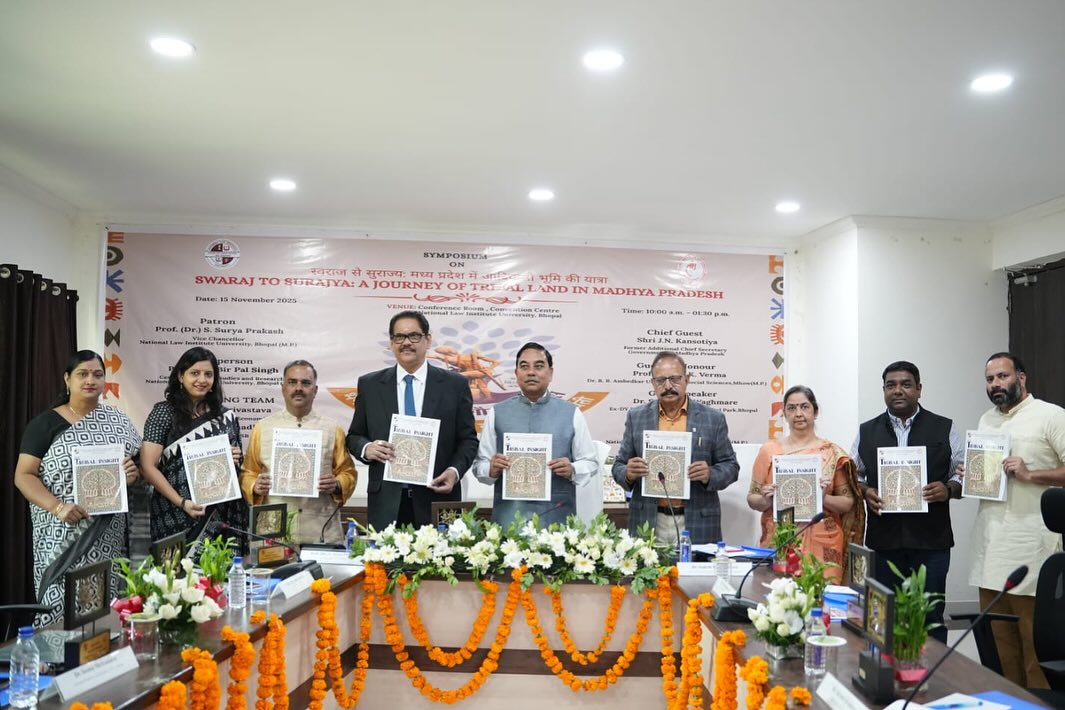
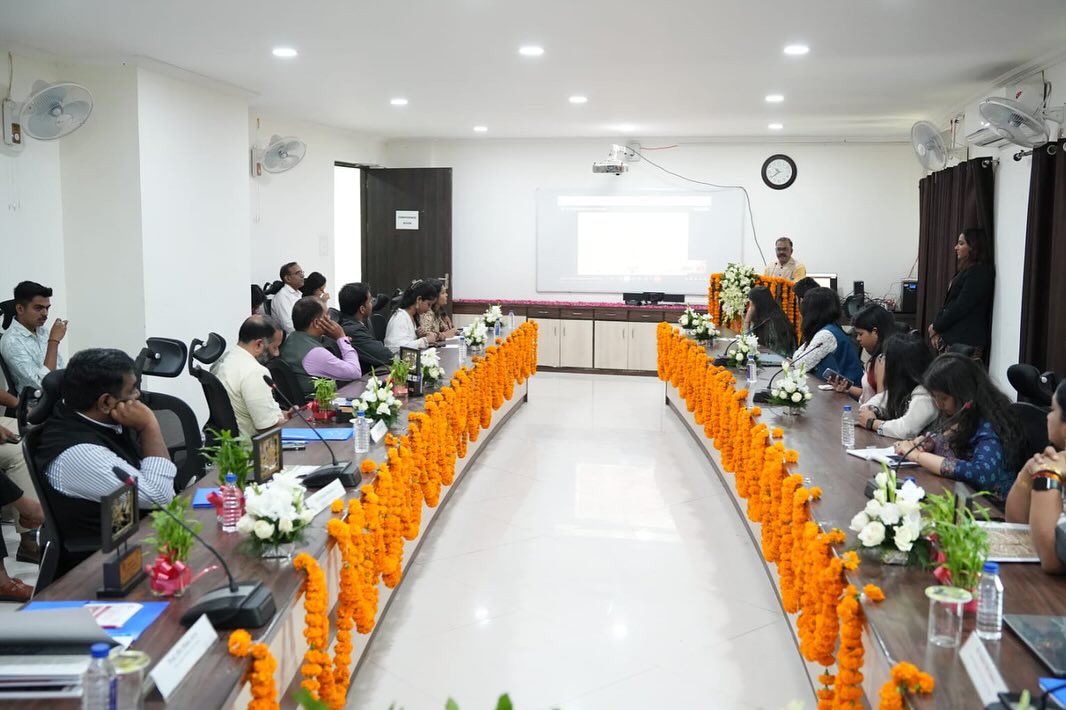
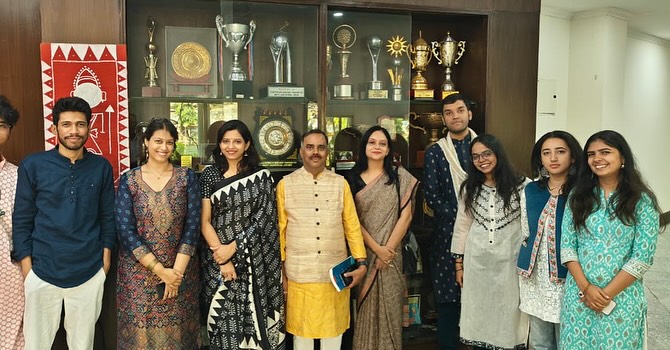
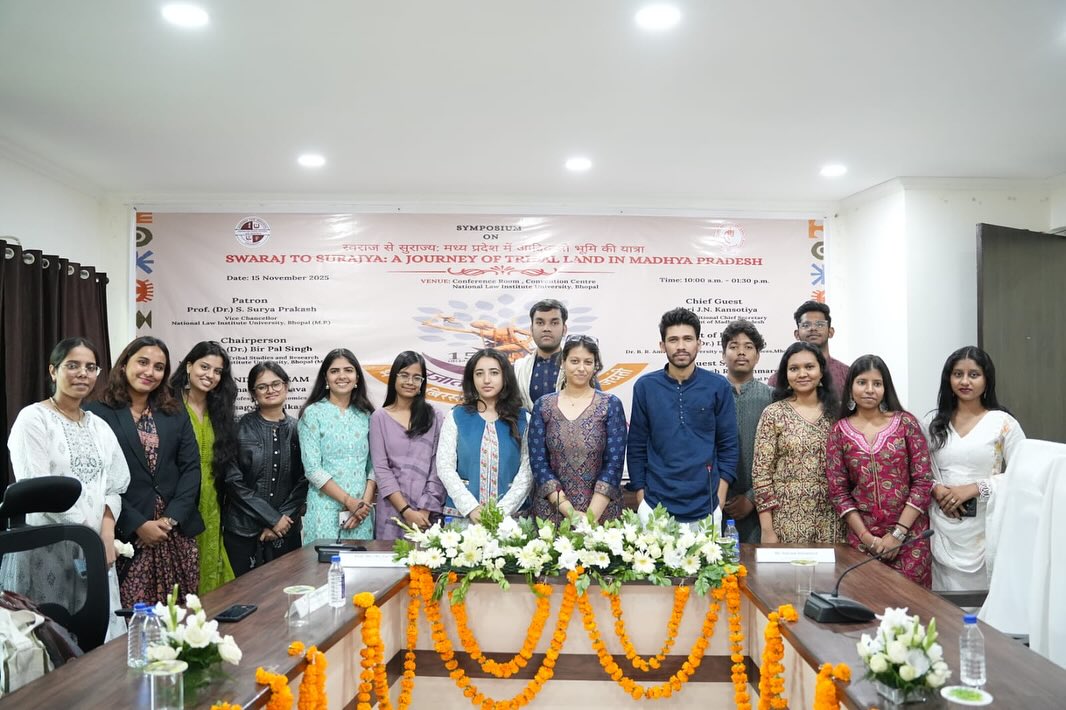
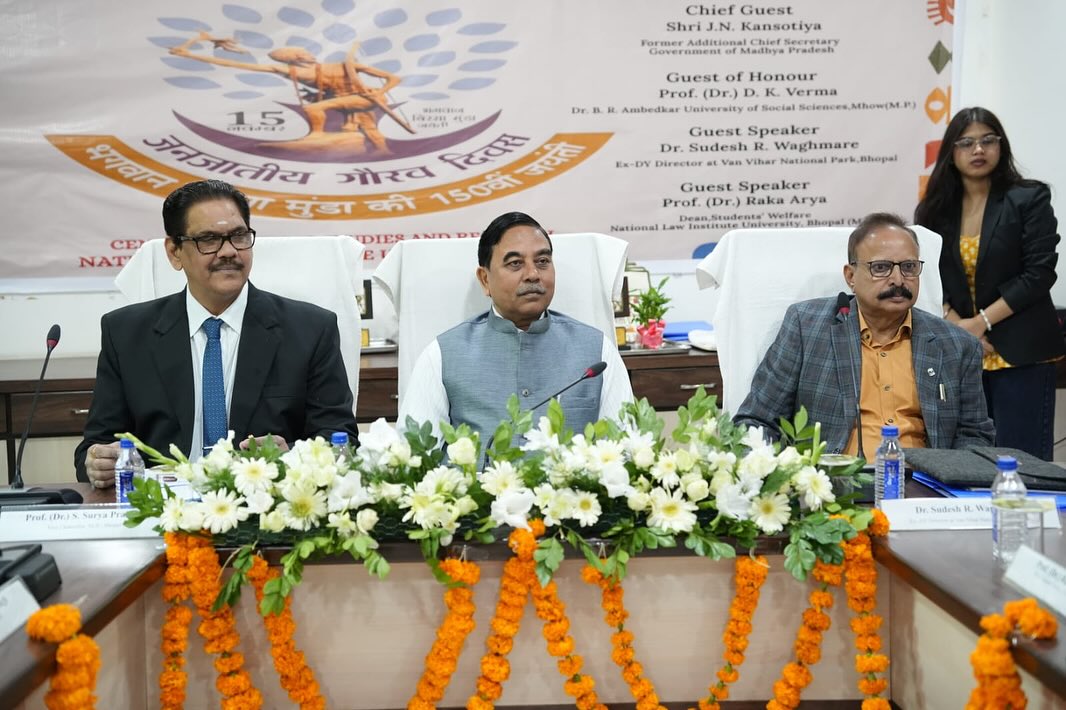
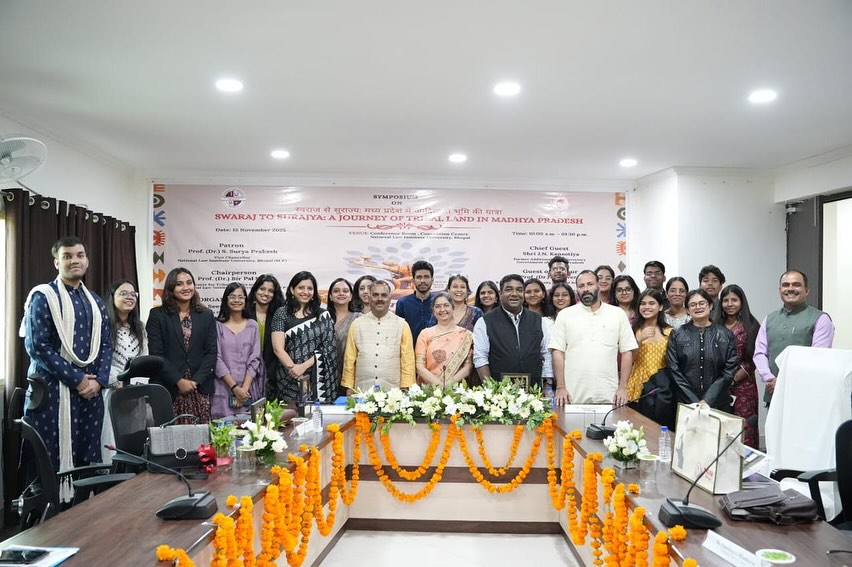
The Centre for Tribal Studies and Research (CTSR), National Law Institute University, Bhopal, organised a one-day symposium titled ‘Swaraj to Surajya: A Journey of Tribal Land in Madhya Pradesh’ to commemorate Janjatiya Gaurav Diwas on Saturday, 15th November 2025 at the Conference Hall, Justice J.S. Verma Convention Centre, NLIU, Bhopal. The event brought together academicians, administrators, NGO representatives and students to engage in an informed dialogue on tribal land, governance and development in Madhya Pradesh.
The symposium commenced with an inaugural ceremony and lighting of the lamp, after which Ms. Saubhagya Bhadkaria, the Coordinator of the Centre and the Moderator for the discussion, extended a warm welcome to the attendees and introduced the theme.
The Welcome Address was delivered by Prof. (Dr.) S. Surya Prakash, Vice Chancellor, NLIU. Prof. (Dr.) S. Surya Prakash warmly welcomed Shri J. N. Kansotiya, Dr. Sudesh R. Waghmare, and all dignitaries to the symposium organised in honour of Birsa Munda Jayanti. He emphasised the significance of remembering Bhagwan Birsa Munda, whose life represents tribal pride, resistance, and the enduring struggle to protect land and identity. Speaking on the theme, he noted that the journey from Swaraj to Surajya must prioritise the upliftment of tribal communities who have safeguarded India’s forests, rivers, and biodiversity for centuries.
Prof. Prakash reflected on the transformation of the term “Vanvasi” to “Adivasi,” acknowledging the deep cultural, spiritual and historical identity of tribal groups. Drawing from the Ramayana, he highlighted Rishi Valmiki’s depiction of forest life and tribal values, reminding that dharma, in all its dimensions including justice, shapes Indian society. He stressed that tribal communities prefer harmonious coexistence with nature, and any engagement with them must be respectful, minimal, and based on consent.
He further noted ongoing research identifying nearly 400 tribal warriors whose contributions remain under-recognised, and recalled the valour of Rani Durgavati of Gondwana. Concluding, he stated that the symposium’s theme is crucial for understanding governance, cultural dignity, and inclusive development for tribal communities in Madhya Pradesh.
This was followed by the introduction and release of The Tribal Insight, Volume 2 Issue II, the Centre’s flagship publication aimed at promoting research on tribal issues.
SESSION 1:
The first session commenced with an introduction to the theme by Prof. (Dr.) Bir Pal Singh, Chairperson of CTSR. He pointed out that tribal India story cannot be interpreted without acknowledging the great role played by Birsa Munda whose movement symbolised resistance, identity and protection of tribal land. He emphasized the fact that although Birsa Munda is a very well-remembered name, there were many other tribal freedom fighters whose names have been lost in the historical pages and our task is to make their names known to all.
He pointed out that educators and schools have an extraordinary role of introducing students to tribal culture, history and traditions as these rich heritage systems must be preserved and honored. He emphasized on CTSR’s commitment to encourage research, dialogue and events that bring attention to the issues faced by tribal communities. He also recommended that attention must be paid to the lesser-known tribes and he urged NGO representatives to make these groups gain recognition.
This was followed by the Guest Speaker address by Dr. Sudesh R. Waghmare, Ex-Deputy Director, Van Vihar National Park, Bhopal. The engaging and insightful address brought the audience back almost 3,000 years demonstrating the historical presence of tribes and the rich cultural heritage of communities in India. He emphasized how important tribal communities have been in influencing knowledge systems, innovations and ecological expertise in India. His stories were an indication of his deep admiration of tribal groups and the incredible value they add to society. Dr. Waghmare also tracked the history and development of the Forest Rights Act, 2006. He underscored the fact that the Act offers primacy and priority rights to the tribal communities as they have never underestimated the true worth of forests and have coexisted with nature. At the end of his speech, he added that it is not just necessary to empower tribal population to ensure justice but also to protect the Indian environment and culture.
The session was then enriched by an insightful address by the Chief Guest, Shri J.N. Kansotiya, former Additional Chief Secretary, Government of Madhya Pradesh.
He noted that the 150th Jayanti of Bhagwan Birsa Munda must be celebrated with deep respect, remembering his fight for tribal rights against British rule. Sir pointed out that his struggle for Jal, Jungle, and Jameen continues to inspire generations. He highlighted that Madhya Pradesh has a significant percentage of tribal population, that is, nearly 21% of the entire state population1 with major tribes such as Gond and regions like Rewa, Dindori, Jabalpur, Jhabua, and Alirajpur having significant tribal presence.
He noted that tribal communities revere nature and prefer peaceful coexistence. Although development has brought some change, challenges remain. Literacy levels are still low, especially in Alirajpur and the life expectancy of a tribal (around 58 years) is 12 years lesser than an average Indian. Economic progress is slow, and very few tribal people reach higher positions in civil services or the private sector. Equality in education and employment is still distant; only 4 out of 100 tribal children reach college. Health issues, malnutrition, weak governance, and lack of representation were identified as major concerns. Schemes like Awas Yojana and studying Section 71B, SC/ST Act, and land rights were emphasised as crucial for tribal upliftmentand he encouraged the students to research on and encourage discourse on these issues.
A brief Vote of Thanks was offered by Dr. Seema Shrivastava, Assistant Professor of Economics, NLIU. The session concluded with High Tea.
SESSION 2:
The symposium resumed after a short high tea break with Ms. Saubhagya Bhadkaria underscoring the significance of revisiting the transition from Swaraj to Surajya, particularly in relation to tribal empowerment, land autonomy, and the promises enshrined in the Constitution.
The keynote address was presented by Prof. (Dr.) Raka Arya, Dean of Students’ Welfare at NLIU Bhopal. She discussed the historical development of tribal land administration, the resilience exhibited by indigenous communities, and the ongoing discrepancies between policy frameworks and actual conditions on the ground. She stressed the necessity of prioritizing tribal agency within legal discussions and enhancing institutional mechanisms that protect land, livelihood, and identity.
Subsequently, Mr. Satyam Srivastava from Azim Premji University, Bhopal shared his thoughts on the socio-economic consequences of land alienation and highlighted the critical need for data-driven, participatory policy interventions. He also recited a reflective poem associating it to tribal life, highlighting how tribal voices often remain invisible in mainstream literature and how stories from childhood shape our understanding of the bond between people and forests.
The session continued with featuring of inputs from NGOs. Mr. Anish, esteemed part of Ekta Foundation-Parishad provided field-based insights regarding community involvement and the real challenges faced in securing land titles under initiatives such as the Forest Rights Act. From field stories to practical policy concerns, the conversation highlighted how land, identity, and justice remain deeply connected for tribal communities even today. He encouraged the attendees as law students and academicians to look beyond textual knowledge and use that knowledge for upliftment of tribal communities.
The symposium then transitioned to an open discussion, encouraging questions and reflections from students, faculty members, and practitioners. This interactive segment facilitated a more profound exploration of current issues, including administrative obstacles, the role of civil society, and emerging models of tribal self-governance.
A short piece on substantive justice and marginalisation, emphasising how legal systems often overlook the lived realities of tribal communities was then presented by a student member of CTSR.The programme concluded with a Vote of Thanks presented by Ms. Chelsy Mehta, Convenor, CTSR, who expressed appreciation to the speakers, participants, and organizers, and closed the session by reminding everyone of the enduring words and spirit of Bhagwan Birsa Munda, whose vision continues to guide struggles for justice and dignity.In her concluding remarks, Moderator Ms. Saubhagya Bhadkaria summarized the discussion, emphasizing the significance of interdisciplinary research and ongoing institutional involvement with tribal communities.The event concluded with the National Anthem, after which lunch was served.